
A five-star hotel. A popular pizza chain. A neighbourhood restaurant.
We assume that if we are paying more or choosing a well-known brand, food safety is automatically taken care of. But recent inspections across Bengaluru and Maharashtra have challenged that assumption.
In Bengaluru, food-safety officials inspected 60 three- and five-star hotels and reported seizing 1,089 kg of food and other products over alleged violations, including expired food. In Maharashtra, inspections of major restaurant chains resulted in the suspension of licences at four Domino’s outlets and one Pizza Hut outlet after authorities reported hygiene violations including insect infestation, grease accumulation and missing expiry information.
These cases are concerning, but they also raise a more important question:
Where exactly does food safety fail?
The answer is not always in the cooking process. It can begin much earlier.
It Starts Before the Food Enters the Kitchen
Food safety begins with what a restaurant buys and from whom it buys it.
Meat, seafood, dairy, eggs, frozen foods and other high-risk ingredients need greater attention because poor handling before delivery can already compromise their safety.
That is why supplier selection and monitoring matter. A restaurant should know its suppliers, define what it expects from incoming products and review supplier performance when problems repeatedly occur.
But even a reliable supplier cannot replace the next important step:
Receiving inspection.
Receiving: The First Opportunity to Say “No”
When a delivery arrives, accepting everything without checking defeats the purpose of having a food-safety system.
The receiving team should look at the product’s:
- Packaging and signs of damage or leakage
- Expiry/use-by dates and labels
- Appearance, colour, texture and odour
- Temperature, where temperature control is required
- Overall condition and suitability for use
If something does not meet the restaurant’s acceptance criteria, it should be rejected or appropriately segregated and recorded.
These records are more than paperwork. If the same supplier repeatedly sends damaged, expired or temperature-abused products, the restaurant has evidence that something needs to change.
Accepted Food Can Still Become Unsafe
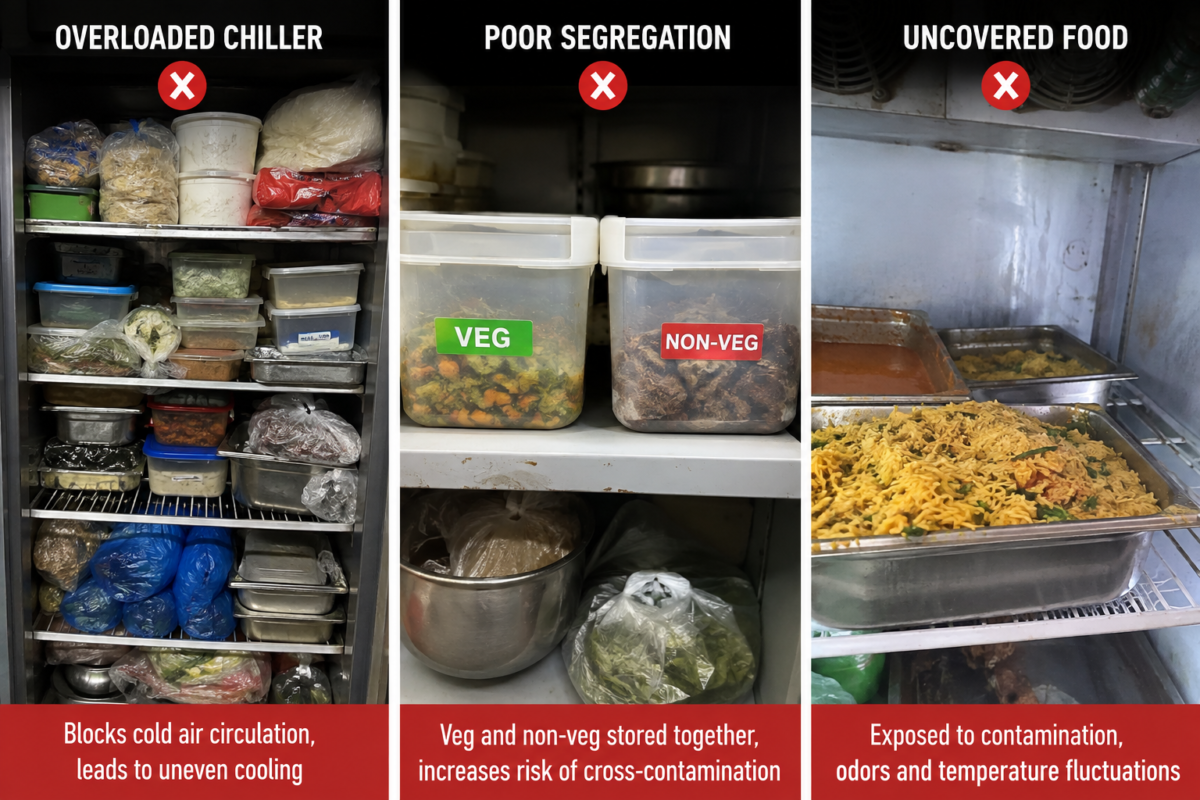
This is where storage and stock management become critical.
A product can arrive in perfect condition and still become unsafe because of:
- Incorrect refrigeration
- Overloaded chillers
- Poor segregation
- Uncovered food
- Inadequate temperature monitoring
- Poor stock rotation
This is why FIFO (First In, First Out) and FEFO (First Expired, First Out) matter.
And labelling matters just as much. In a busy kitchen, an unidentified container can quickly become forgotten stock.
The Invisible Risk: Cross-Contamination
Not every food-safety problem is visible.
A cutting board used for raw chicken and then for ready-to-eat food without proper cleaning and sanitisation can transfer harmful microorganisms even when the food itself looks completely normal.
The same principle applies to:
Raw and cooked food.
Vegetarian and non-vegetarian food.
Food and chemicals.
Clean and dirty equipment.
Safe thawing, hand hygiene and proper sanitation are therefore not small housekeeping tasks. They are essential controls.
Cooking Is Not a “Reset Button”
One common misconception is that cooking can fix everything.
It cannot.
Cooking is an important safety control, but it does not make spoiled, expired or otherwise unsuitable raw material acceptable.
And food safety does not end after cooking. Improper cooling, reheating, hot or cold holding and service can introduce new risks.
Cooked does not automatically mean safe.
The Bigger Problem: Compliance vs Reality
Perhaps the biggest lesson from these inspections is that having a food-safety system is different from actually following one.
A restaurant can have:
- Temperature records
- Cleaning schedules
- Pest-control reports
- Receiving checklists
- Training records
- FIFO/FEFO procedures
But what happens when the actual kitchen does not match the records?
A temperature log may say 4°C while the refrigerator is actually at 9°C.
A cleaning checklist may be signed while equipment still has grease build-up.
A product may be marked “accepted” despite showing signs of deterioration.
This is where verification becomes more important than documentation.
Food Safety Should Not Depend on an Inspector
An inspection captures a moment.
Food safety is a daily responsibility.
The real test is whether a restaurant continues to follow its procedures during a busy dinner service, when staff are short, when deliveries arrive unexpectedly and when no inspector is present.
Recent enforcement across India is therefore more than a series of restaurant raids. It is a reminder that food safety is a chain:
Supplier → Receiving → Storage → Preparation → Cooking → Holding → Service → Consumer
If one link fails, another should detect and correct it.
The question we should be asking is not:
“Does this restaurant have a food-safety system?”
It is:
“Does that system actually work when nobody is watching?”
Because food safety is not created when the plate reaches the table.
It is protected at every step before it gets there.