
Exploring how high-tech food innovations are reshaping safety standards across the globe.
Imagine biting into a juicy, rich burger that never came from a farm, drinking milk made with proteins produced by tiny microorganisms, or eating a meal 3D-printed right before your eyes.
While this sounds like a scene from a futuristic sci-fi film, many of these technologies are already being developed, and some are reaching consumers. As global food demand grows and the need for sustainable food systems increases, scientists and food companies are reimagining how we make our food.
However, with brand-new ways of making food come brand-new food-safety questions.
New Ways to Make Food Need New Ways to Protect It
Traditional food-safety systems were largely developed around familiar foods, ingredients, and established production methods. But future foods bring new ingredients, specialized microorganisms, laboratory environments, and novel processing methods into the equation.
Because of this, food-safety experts need to ask more than just, “Is this food safe to eat right now?”
They must also investigate:
- How was this made?
- What new risks or hazards could pop up?
- How do we catch and control those hazards early?
Ensuring these emerging systems are safe requires continuous monitoring, thorough testing, and active collaboration between scientists, technology developers, and food regulators.
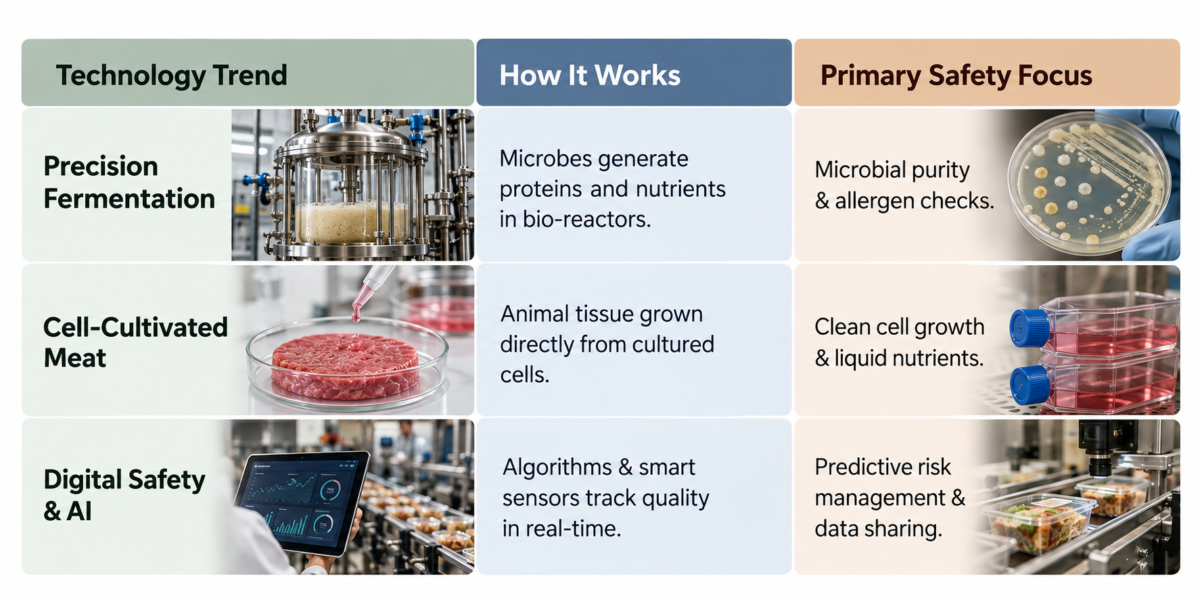
These innovations show that the future of food is not just about creating new ways to produce food—it is also about developing smarter ways to keep it safe.
What Does This Mean for India?
India is also preparing for this new wave of food innovation.
The Food Safety and Standards Authority of India (FSSAI) has established frameworks for Novel Foods, alongside regulations for health supplements, nutraceuticals, and functional foods.
As food-tech start-ups enter the Indian market, regulatory frameworks will continue evolving to support innovation while keeping consumer health and safety as the top priority.
The Bottom Line: Safety First, Always
The food of tomorrow might be brewed in tanks, grown from cells, printed by machines, or monitored by artificial intelligence. But one basic truth will never change:
Food must be safe.
Sustainable food innovations are exciting, but safety can never be an afterthought. Safety must be built into the process from day one from the initial cell culture or microorganism to the final bite on your plate.
After all, the future of food isn’t just about what delicious things we will eat it’s about how safely and responsibly we can create them.